Last pilot whale guided out to sea
Whale rescuers today successfully returned the last live whale stranded on Naracoopa Beach to the water. Parks and Wildlife Service Reserves manager Chris Arthur said the adult female pilot whale was slung between two jet skis and taken off-shore before being released. "The whale was seen to swim toward a group of whales in the area, several of which had been tagged by rescuers two days earlier." This rescue effort has seen 54 pilot whales and five bottlenose dolphins successfully returned to the sea. "It has been a fantastic effort by everyone involved, particularly the King Island community, who have assisted in making possible one of the largest successful whale rescues in the State's history," Mr Arthur said.
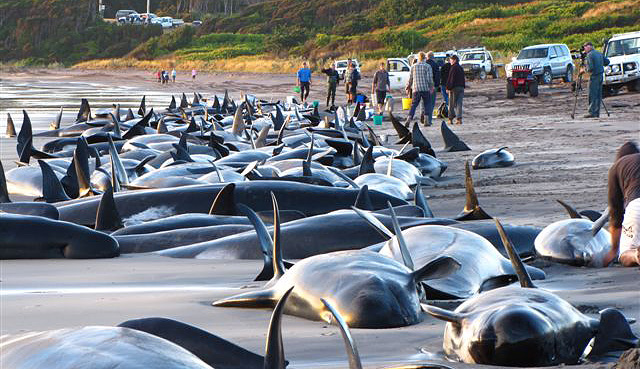
Bron: The Mercury 2/3/9
SIX dolphins stranded among almost 200 whales on King Island have been returned to the water.
The people at Naracoopa beach worked from first light to save the 54 whales and six dolphins which were alive this morning. Professionals from Tasmania's mainland have now arrived and with the tide coming back in, King Island Council general manager Andrew Wardlaw is confident the bigger animals can also be freed from the sand.
About 140 pilot whales have already died on the beach. "There is such a mess of bodies down here but the community has rallied and kept the surviving whales alive with bucket brigades and other measures," Mr Wardlaw said as he and about 200 others continued their efforts. "The locals have got everything ready and now the professionals have arrived. I am hoping we have the manpower to save the animals."
John Nievaart, from Naracoopa Holiday Units, is one of the volunteers who has spent the morning trying to save the mammals. "It is pretty darn sad, you can hear them crying," he said. "There are as many volunteers as whales down here. We are keeping them wet and have got them covered with anything we could get our hands on, bedspreads, blankets and towels." Some students from Clarendon College in Victoria managed to get a baby whale back in the water but it came back to the pod twice. "It was heartbreaking to watch. Mr Nievaart said excavators had dug channels ready for the incoming tide. "We have also been digging around the individual whales to give them a pool of water to rest in. The tide is due back in at 3.30pm. Let's hope our show of human strength is enough," he said.
The news comes after 48 sperm whales died at Perkins Island near Smithton in January. The huge whales, the same species as the fictitious Moby Dick, were wedged on sandbanks and died slowly despite efforts to save them. That was the second-largest sperm whale stranding in Tasmania. The largest was in 1998 when 66 whales were stranded on Ocean Beach near Strahan. Just three months ago, 155 long-finned pilot whales perished on a beach near Sandy Cape on the West Coast. Another 32 were saved by a fisherman who liaised with whale experts and used his boat to herd the pod to sea.
Just a week before, a pod of 64 female pilot whales and calves was stranded on Anthonys Beach at Stanley. Eleven were rescued by moving them to another beach. Satellite trackers were put on five of the 11 survivors.
Pilot whales are the most common species to strand, accounting for about 70 reports totalling about 3000 animals in Tasmania alone. Last month State Government whale rescuers hit back at claims that rescues could have been better managed after the deaths of all 48 sperm whales near Smithton. CSIRO and University of Tasmania scientists have linked a peak in a wind pattern cycle, which brings prey, with frequency of stranding.
Tasmania is the world's hotspot for strandings, the causes of which are unknown. In 2005 the Royal Australian Navy said it would avoid operations in areas where whales were beaching. It was responding to a report by the Department of Environment showing a possibility of stressed whales being further upset by noise, after 145 whales and dolphins died at Marion Bay on the East Coast in late October 2005. A naval vessel was using sonar at the time of some of the strandings.
Parks and Wildlife senior ranger Chris Arthur will flew to the Bass Strait island this morning to see how many survivors could be saved. "While animals are alive there is still hope. About 50 of those are pilot whales the others are bottlenose dolphins," Mr Arthur said. Authorities were alerted to the stranding late on Sunday.
Bron: Parks & Wildlife Service 2/3/9
King Island Whale stranding
Efforts by rescue crews and volunteers have saved 54 pilot whales and 5 dolphins stranded on Naracoopa Beach at King Island. The whales are among a group of 192 whales that stranded yesterday (Sunday) evening. Parks and Wildlife Service (PWS) and Department of Primary Industries and Water marine conservation officers arrived at the scene this morning to find 54 whales and 5 dolphins alive. Chris Arthur from the Parks and Wildlife Service said about 140 of the animals had died, but hopes were high that the remaining whales could be saved. "The 150-strong group of professionals and registered volunteers have worked throughout the high tide to refloat the animals," said Chris. "We will continue until dark and start again at first light tomorrow". Mr Arthur said it was not uncommon to have both whales and dolphins strand simultaneously. On 28 November 2004 a group of 97 long-finned whales and bottle nosed dolphins beached at Sea Elephant Bay in King Island. All animals that had stranded died although the live whales and dolphins that were milling in shallow water were successfully escorted back to sea. Tasmania remains a hot spot for strandings with over 80 per cent of Australia's mass stranding events occurring in Tasmania. "This last summer has been a particularly demanding one, not only for the specialist Parks and Wildlife Service officers, staff of DPIW, but also the, volunteers and local communities who have worked together at four major strandings this summer," Chris said.
Bron: AD 23/1/9
SYNDEY - Bijna vijftig potvissen zijn overleden nadat ze waren gestrand op een zandbank bij het Australische eiland Tasmanië. Dat meldden Australische media vrijdag.
De walvissen werden donderdag ontdekt bij Perkins Island aan de noordwestkust van Tasmanië, ten zuidoosten van het Australische vasteland. De meeste waren toen al dood. Natuurbeschermers proberen de vijf nog levende exemplaren met man en macht te redden. Overdag zijn ze nat gehouden om ze te beschermen voor oververhitting. Met hoogtij wordt zaterdag geprobeerd de potvissen naar de zee te leiden. Vooral door hun enorme omvang is dat lastig. Mannetjes worden tot 18 meter lang en vrouwtjes tot 11 meter. Het gewicht kan tot 50 ton bedragen.
Walvissen stranden wel vaker in groepen. De reden waarom dat gebeurt, is niet bekend. Walvissen die gered worden zijn zo gedesoriënteerd dat ze vaak opnieuw in de verkeerde richting zwemmen en stranden.
Bron: AD 22/11/8
SYDNEY - Tientallen grienden zijn gestrand op de noordelijke kust van het eiland Tasmanië ten zuiden van Australië. Zeker vijftig dieren kwamen daardoor om het leven, meldden natuurbeschermers zaterdag. Vrijwilligers proberen de nog levende dolfijnachtigen terug te krijgen in zee. Uit de regio komen speciale trailers die de grienden kunnen vervoeren. Ondertussen worden de dieren natgehouden, om te voorkomen dat ze uitdrogen en verbranden door de zon.
Grienden zijn familie van de dolfijn, maar gedragen zich volgens experts meer als walvissen. Walvissen stranden wel vaker in groepen. De reden waarom dat gebeurt, is niet bekend.